Polar sundials for squares · for developers
A ribbon that writes the time in light
The Sun shines through the numbers cut into an anthracite ribbon with gold edges, and bright numbers appear in the shadow on the paving. The shadow of the cable that forms the sundial’s axis travels across them during the day and shows the full hour, quarter past, half past and quarter to.
- Catch the time in your palm and take a photo
- No electronics, the time never needs setting
- Calculated for your square
- A sculpture, a landmark and a meeting place
The sundial was designed by Jan Lochmann, who calculated and engineered the sundial on the chapel tower in Prague-Běchovice and simulates sunlight for property.
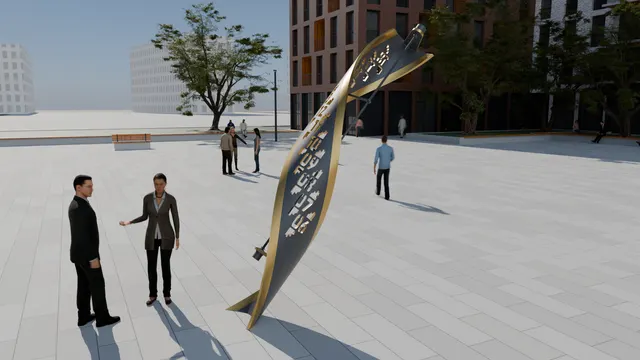
Video
One summer day in light
Sunlight passes through the numerals in the ribbon, writes the hour in light on the paving, and the cable’s shadow moves across them like a clock hand.
Visualisation: an imagined square, with the Sun on its true path over Prague on 21 June. The time in the corner of the video (LAT) is the sundial’s own local apparent solar time.
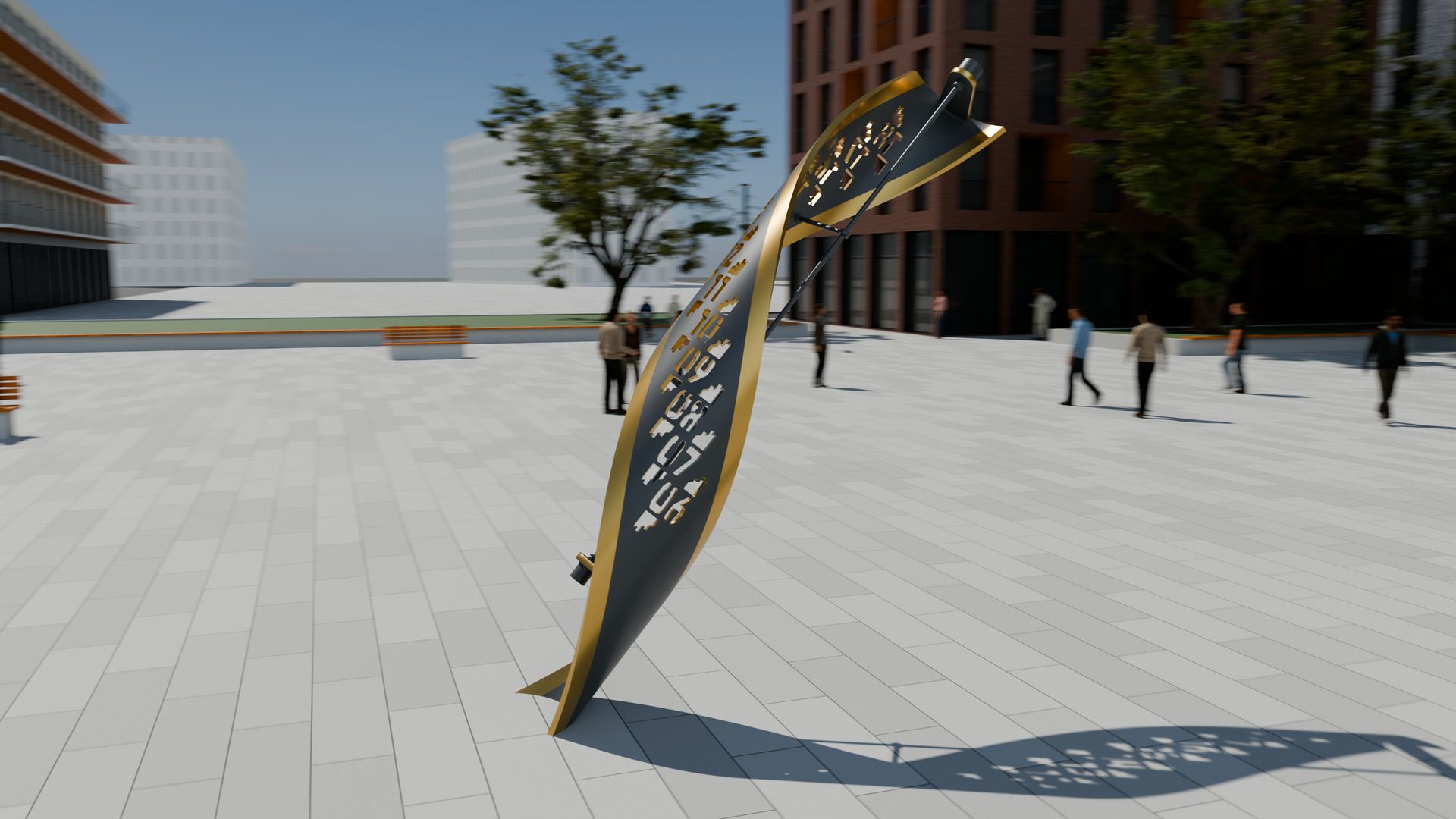
01 Reading the time
The cable’s shadow shows the time on the bright numbers
No dial, no hands: the time is shown by light passing through the numbers and by the dark stripe of the cable’s shadow.
Bright numbers and wedges
In the ribbon’s shadow a few bright numbers around the current hour glow on the paving. Each number has two bright wedges with steps at its sides, like a ruler: the “before” wedge measures the time before the full hour, the “after” wedge the time after it.
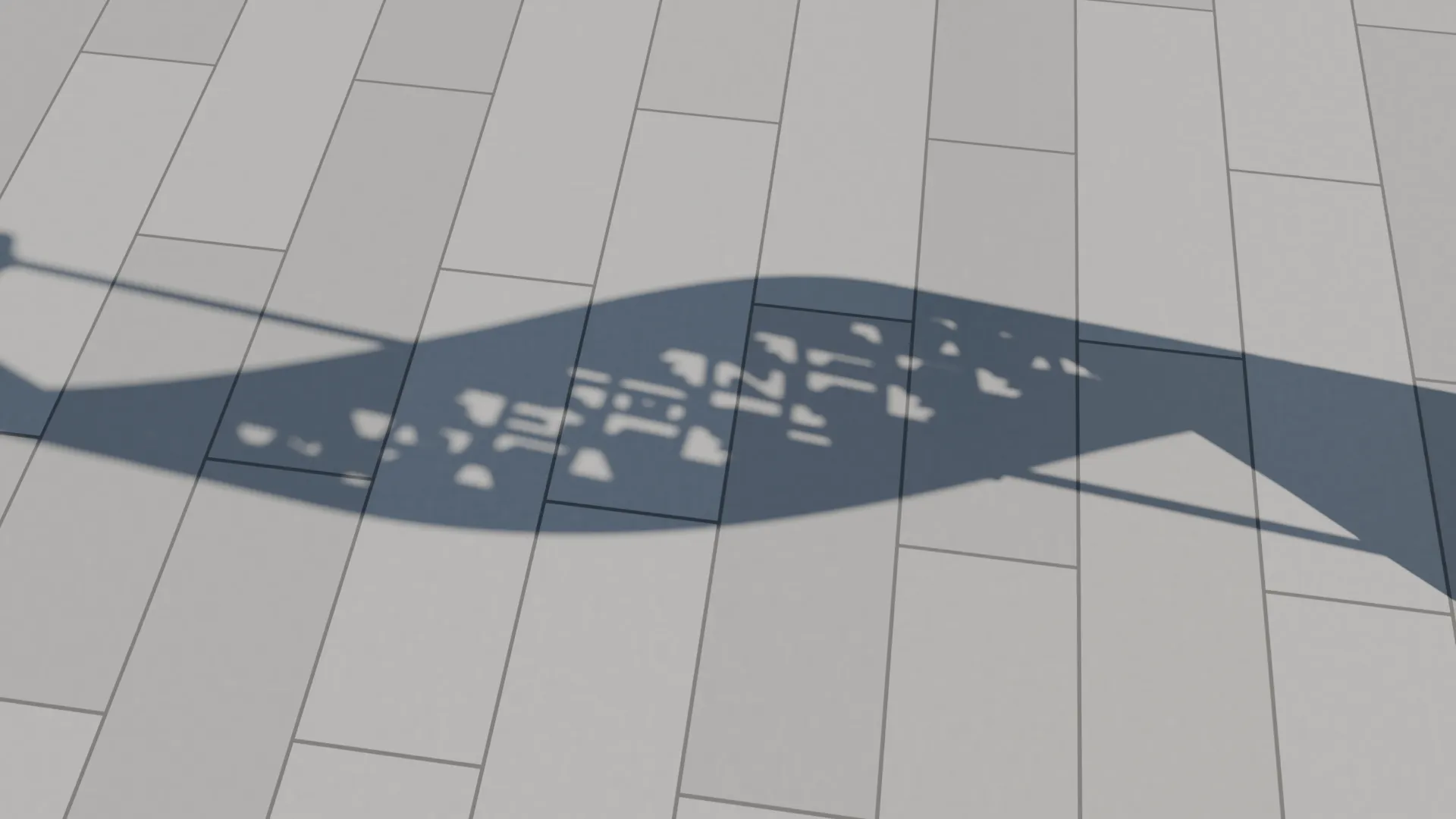
On the hour
On the hour the cable’s shadow runs through the centre of the number and clips the tips of its two wedges: when it runs through the centre of the 12, it is 12 o’clock.
Quarter past, half past, quarter to
Then the shadow moves along the “after” wedge towards its wide end: the first step is quarter past, the second half past, the end of the wedge quarter to. The step it is crossing vanishes into the shadow.
- cable’s shadow at half past twelve
- past the centre of 12: 12 counts
- 12’s after wedge: second step, half past
- first step: quarter past
- 13’s before wedge: half-hour step
- time runs
Which number counts
The shadow travels from the lower number to the higher one. From quarter past to quarter to it also lies on the “before” wedge of the next number, then only on that wedge, and it reaches its tip at the next full hour. The number that counts is always the one whose centre the shadow passed last, even when it already lies on the next number’s wedge. The minutes show how far along the wedge it has got. At half past twelve the shadow has already passed the centre of the 12, so the number that counts is 12.
Catch the time in your palm
Hold your palm, a bag or a sheet of paper in the light close to the sundial, behind the cable. The number and the cable’s shadow fall on it more sharply than on the paving, and you can take a photo of the time. In front of the cable its shadow is missing, so you cannot read the time.
The seasons
In summer the Sun stands high and the numbers are drawn on the paving at their sharpest. In spring and autumn their outlines are softer and they read the same. In winter the Sun stands low and the numbers glow softly on the paving. Your palm behind the cable shows the time sharply in every season.
The sundial shows local apparent solar time, so over the year it runs ahead of watches and then behind. A QR code on the sundial shows today’s difference from watches.
02 Form
Ribbon, gold linings and a custom typeface
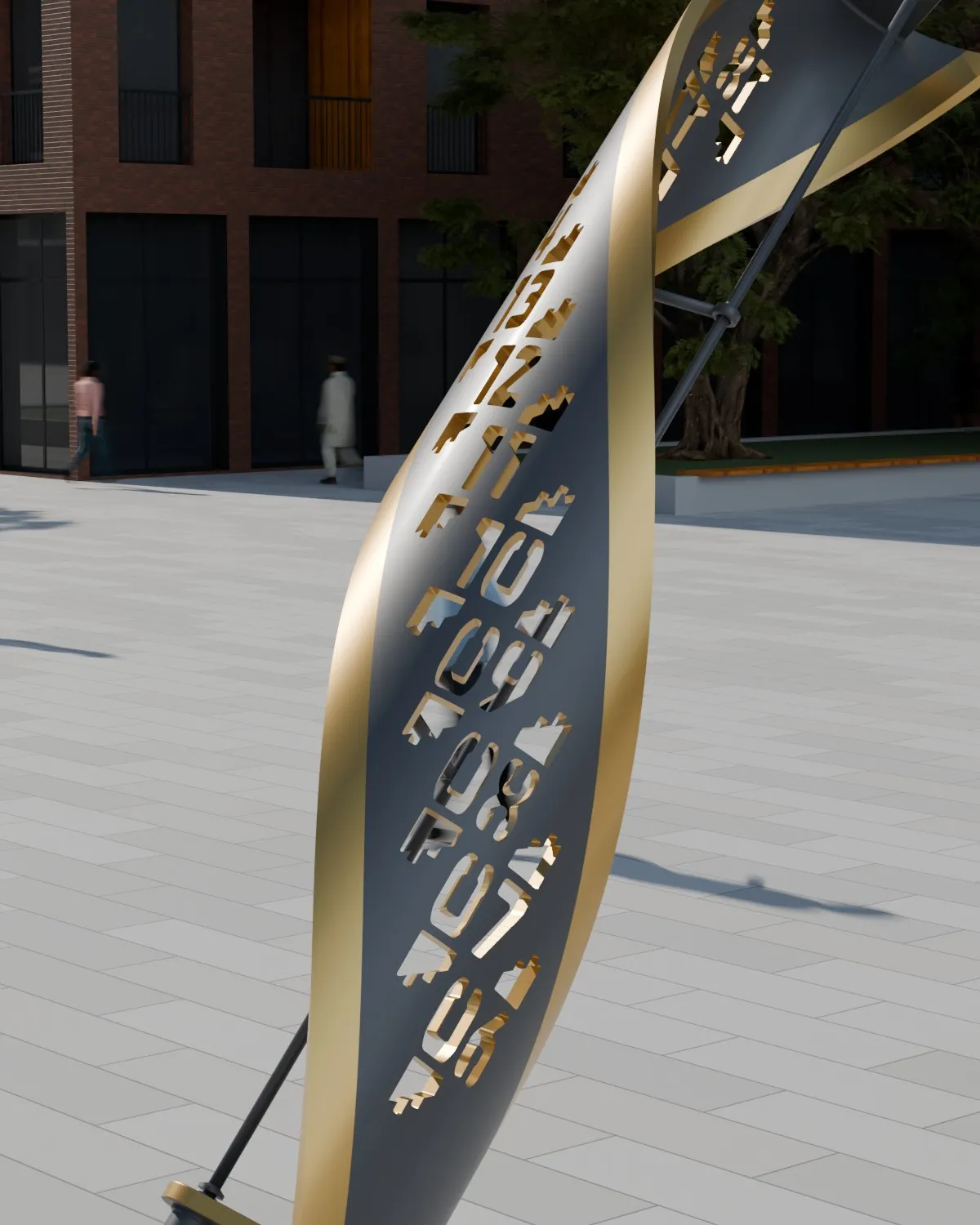
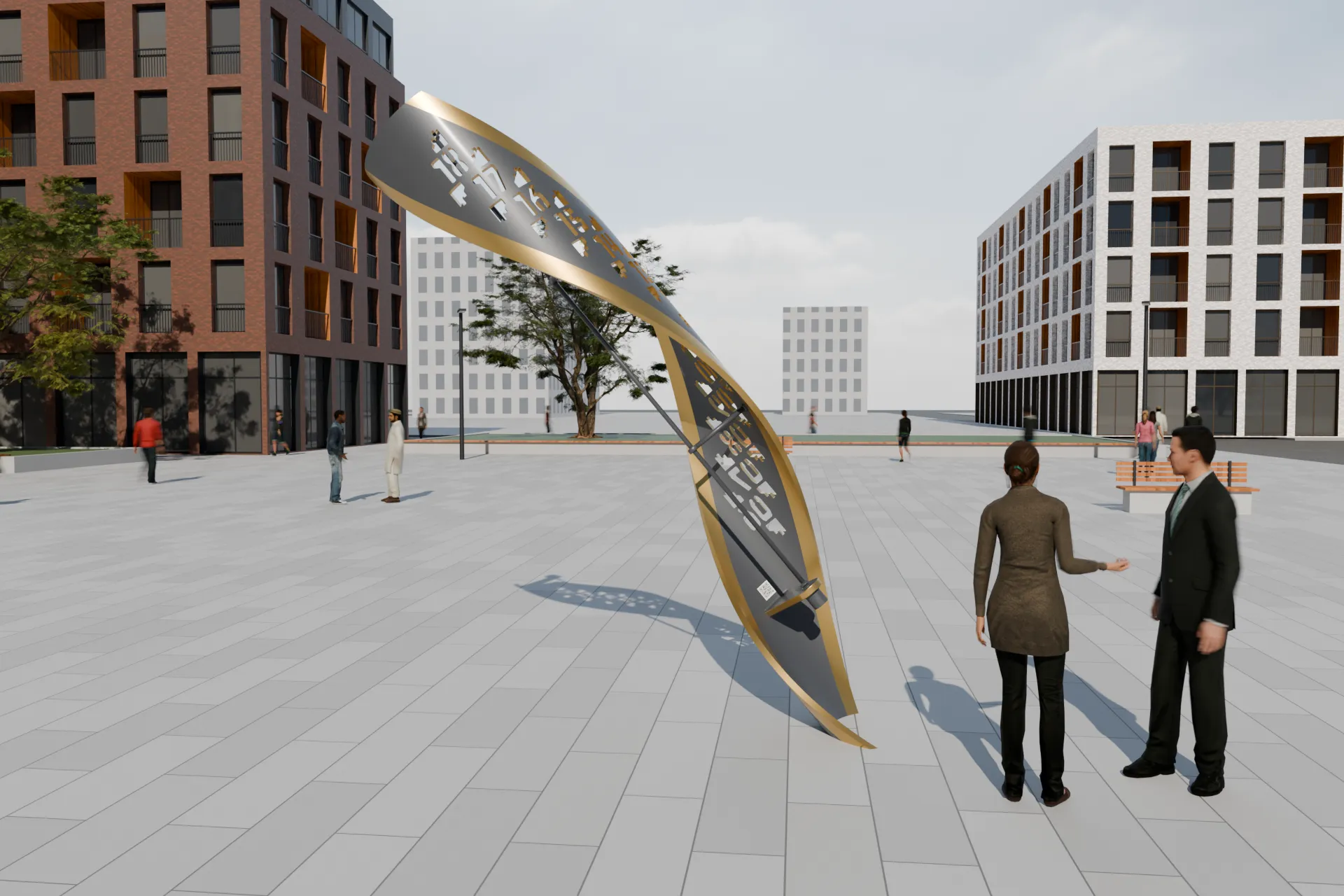
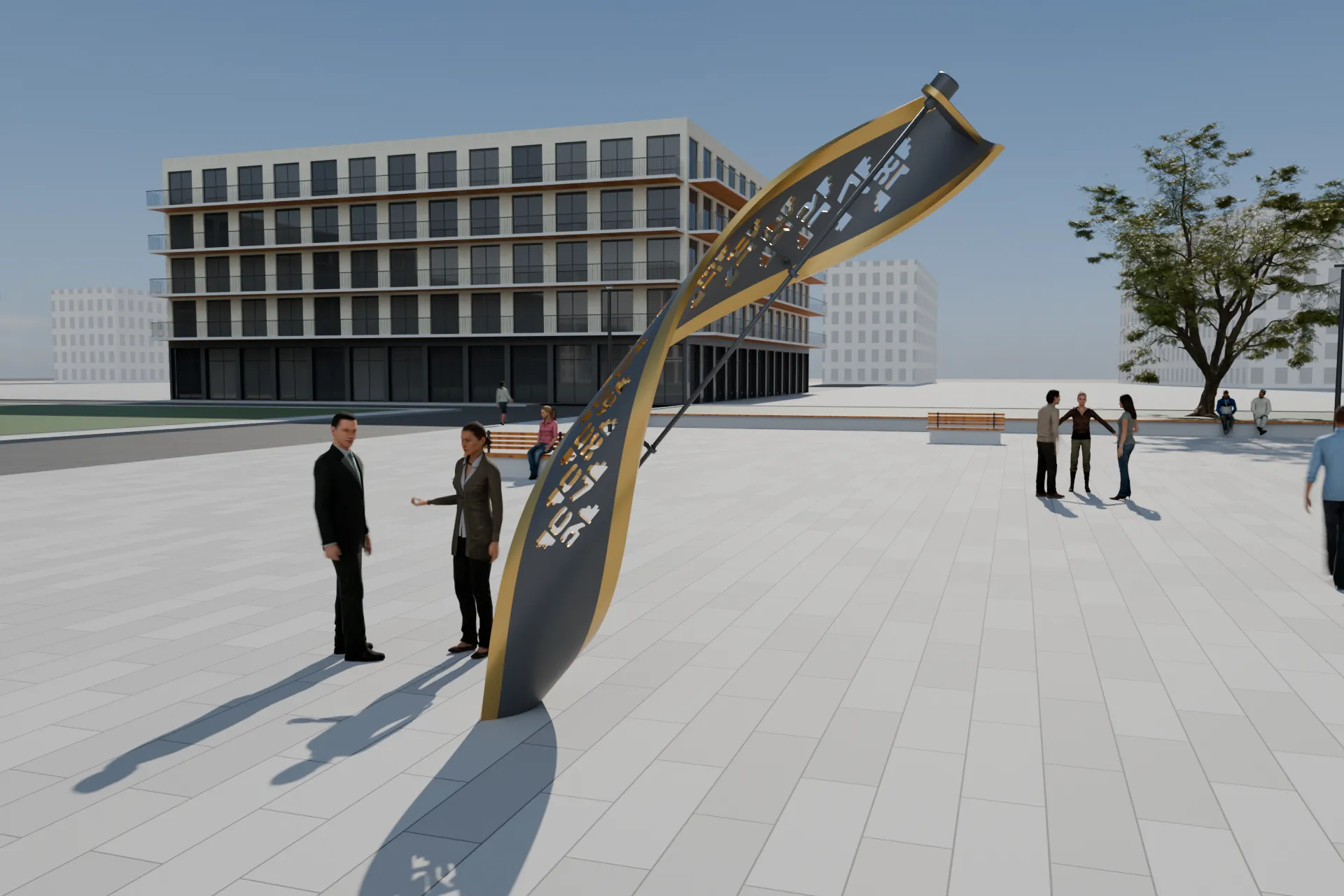
- The ribbon winds around the cable from its foot to its tip: from one side a slender arc against the sky, from another a row of gold-edged numbers, from a third a shadow full of bright patches.
- The surface is anthracite, satin with a subtle metallic sheen. Gold edges trace the ribbon’s outline and a gold lining frames every number.
- The typeface of the numbers is custom, drawn only for this sundial so that the Sun carries the numbers legibly onto the paving.
03 For the project
What the square and the project gain
The sundial is no exhibit behind a fence; it stands on the square among people.
-
A landmark and a meeting place
The sundial becomes the place’s recognisable sign, and people arrange to meet there: “see you at the sundial”.
-
Emotion and a story for sales
A sundial stirs emotion: curiosity, wonder and delight when people catch the time in their palm for the first time. Your project gains a clearly recognisable symbol and a story that is easy to tell in sales and marketing.
-
A concept for the opening event
Open the sundial on an equinox or solstice, at its first solar noon. I supply the script for the event, an information panel with a QR code, a leaflet for residents and a worksheet for schools.
04 Reference
Reference: the Běchovice sundial

For the tower of the Ecumenical Chapel of Angels on the new square in Prague-Běchovice I calculated, designed and engineered the sundial to the architects’ brief. I checked it on a digital twin, and when the gnomon was set, I measured and determined its position and angles.
The reference shows that my calculation works on a real building.
The full story of the Běchovice sundial
The author of the square sundial
I am Jan Lochmann. The polar sundial for squares is entirely my own design, from the form of the ribbon to the typeface of the numerals. The Běchovice sundial is a different type, on the wall of a tower, and its look was set by the architects. What I bring from Běchovice is the calculation and the experience of installation, not the form.
Would you like a sundial like this on your square?
Tell me where the square is being built and what stage the project is at. Developers, architects and municipalities are all welcome to get in touch.
05 The offer
A design for your square
The form of the sundial is designed with manufacture in mind, and its strength is calculated. The project’s structural engineer checks the structure before manufacture.
-
The finished design
- the final form of the sundial
- a custom typeface for the numbers
- a proposed production process with chosen dimensions and materials
- widths of the numeral bridges and openings checked on both the outer and the inner surface of the ribbon
-
Specific to each site
- the position on the square, from a year-round simulation of sunlight between the buildings
- the alignment to true north and the tilt of the axis to suit the latitude
- the foot and lower end of the ribbon to suit the tilt of the axis
- the impact area: where the bright numbers fall over the year
What is fixed and what you adapt to the site
The design can be adapted within functional limits: we design the surroundings and the lower end for the specific site, and some changes to its look are possible by agreement.
- Fixed: what celestial mechanics sets, that is the axis pointing to the celestial pole with a tilt matching the latitude, and the same arrangement of numbers and wedges around the axis everywhere.
- Site condition: the area where the numbers fall over the year must stay clear, with no trees, benches or anything else that would block the sunlight. The paving there should be light for contrast. A slope does not affect reading; it only stretches the image slightly. The brief for the paving is part of the design for the site.
Calculated and verified
- Geometry
- At every full hour the cable’s shadow runs exactly through the centre of the number, at the solstices and at the equinox. Verified in the model.
- Light
- Simulations over the whole year: light through the numbers and wedges, and where the ribbon shades itself.
- Readability
- Simulations in summer, at the equinox, in winter and on the palm. Light passing through the wall of the ribbon and the cable’s shadow are built into the shape of the numbers, so that they are as unlikely as possible to be confused.
- Time
- The difference from watches for every day of the year, from the equation of time and the longitude: the basis for the QR code.
- Structure
- Self-weight, wind and people, including a person hanging from the top edge of the ribbon. Stability, deflections and natural vibration. A several-fold reserve.
- Cable and holders
- Pretension, a person hanging on the cable, the spring mounting, the strength of the holders and welds, and water drainage. Neither the top nor the bottom holder shades any number, and the spacer holders sit where they shade least.
The look of the sundial is protected by an industrial design. Each sundial is calculated for one specific place, and the scope of exclusivity is set by the licence agreement.
06 First step
A study for your square
It shows where and how the sundial will work on your square and what it will look like there, before you decide on the next steps.
- the position and orientation of the sundial on the square
- sunlight on the square over the year, from a 3D model of the surrounding buildings
- where the bright numbers fall over the year
- visualisations of the sundial on your square
-
A design for your square
Production documents for the contractor’s suppliers, including the brief for the structural engineer and surveyor, and a licence for the look of the sundial.
-
Manufacture and installation with technical support
- the brief and documents for the production processes
- work instructions and an installation manual
- checks on manufacture, and consultation
-
The first noon
An opening ceremony following the event concept.
I do not list prices on the website. I deliver the design work myself and sign the contract directly with the developer. The developer pays for manufacture, surface finish, transport, foundation and installation through the project’s building contractor and its suppliers; the paving is also part of the construction.
Who is responsible for what

The project’s building contractor and its suppliers make and install the sundial and are responsible for the workmanship. I am responsible for the design and the calculation: the geometry of the sundial, calculated from celestial mechanics for the specific site. I give technical support during manufacture and installation, so the sundial tells the time accurately.
- Me, the author of the sundial
- the design and calculation for the site, the licence, production documents, technical support
- The project’s building contractor and its suppliers
- manufacture, surface finish, transport, foundation, installation and paving; the warranty on workmanship and finish
- The project’s structural engineer and designer
- structural calculation, loads from people, anchoring and its detail at the waterproofing; checking the structure before manufacture
- Surveyor
- setting out the axis to the true azimuth; checking accuracy without the Sun by surveying the axis’s azimuth and tilt and the positions of the numbers; a check at local apparent noon after installation
07 Questions
Questions by role
Pick the questions you deal with.
Leadership, marketing and salesProject and constructionArchitects and landscape architectsOperation and handover
Leadership, marketing and sales
May we use the visuals from the study in sales?
Visualisations of the sundial on your square are part of the study. You can use them in sales from the moment you order the sundial.
What exclusivity do we get?
Each sundial is calculated for one specific place. The scope of exclusivity is set by the licence agreement.
What makes up the price, and who pays for what?
I do not list prices on the website. I deliver the design work myself and sign the contract directly with the developer. The developer pays for manufacture, surface finish, transport, foundation and installation through the project’s building contractor and its suppliers.
Why does the sundial not show the same time as a watch?
The sundial is set to the local meridian without correction and shows local apparent solar time: twelve is solar noon, when the Sun stands highest. Watches show Central European Time. The difference comes from celestial mechanics: the Earth orbits the Sun on an ellipse and its axis is tilted, so solar noon shifts by a few minutes over the year. Prague also lies a little west of the meridian that Central European Time follows.
In Prague the sundial runs at most about 14 minutes ahead of it (early November) and at most about 16½ minutes behind (mid February); they agree around 27 April, 1 June, 8 September and 21 December. During summer time the sundial is also about an hour behind watches.
Will the municipality take the sundial over?
That is an agreement between the developer and the municipality. The study also includes a short brief for your talks with it.
Project and construction
When in the project should we get in touch?
Ideally one to three years before completion, while the documentation for the public spaces is being finalised. Later, the budget is usually already allocated. The foundation and anchoring need to be prepared during construction.
What does the study need from us?
A site plan of the square, the heights of the surrounding buildings or their 3D model, the terrain, the planned greenery and documents for the foundation.
How is the sundial aligned?
The axis has to point to true north. That differs from north on the construction drawings and from the compass by several degrees, and the sundial would then be wrong by roughly 10 to 30 minutes. A surveyor therefore sets out the axis to the true azimuth, and it is checked at local apparent noon. Include this in the construction specifications.
Does the sundial need a permit?
The project’s designer decides how to include the sundial in the building permit. I supply the documents about the sundial for them.
Architects and landscape architects
Will the sundial get sun between the buildings or in a courtyard?
Buildings to the south, east and west can take the Sun from the sundial in the morning, in the evening and in winter. The position is therefore decided by a sunlight simulation in the study. The sundial also suits a courtyard inside a residential block if there is enough sunlight and room for the area where the numbers fall. If the chosen spot does not work, the study recommends another one.
How readable are the numbers?
The Sun is not a point but a disc half a degree wide, so the edge of the light softens with distance. The numbers therefore use a custom typeface with much wider strokes, and readability is checked in a simulation. How the numbers look in each season is described under How to read the time.
How big is the sundial?
The visualisations with people show the scale.
Why does the sundial stand at a slant?
The axis of the sundial points to the celestial pole, parallel to the Earth’s axis. Its tilt therefore follows the latitude of the site: in Prague the axis meets the ground at 50.08°. The Sun then moves round the sundial’s axis evenly, by 15° an hour, just as the Earth turns.
Operation and handover
What maintenance does the sundial need, and what may the owner and manager do without the author?
The sundial has no electronics and its time never needs setting. Maintenance is as for other fixtures on the square: wash it now and then and inspect the surface and the cable regularly, which the manager can handle. Moving or turning the sundial is only possible with a new calculation, otherwise it would show the wrong time, and changes to its look are possible by agreement with me.
Is it safe?
The cut edges are rounded. We design the surroundings and the lower end for the specific site; the project’s designer assesses the space under the slanted part.
What does the sundial look like in winter and at night?
In winter the Sun stands low and the numbers glow softly on the paving. Your palm behind the cable shows the time sharply in every season. On a cloudy day there is no shadow, and the sundial is a sculpture on light paving. At night it does not show the time, but it can be lit as a sculpture on the square.
Planning a new square?
Ideally get in touch one to three years before completion, while the documentation for the public spaces is being finalised. Tell me where the square is being built and what stage the project is at.