Garden sundial

Setup guide

Enter where the sundial will stand. The guide calculates when true solar noon is at your place, takes you through the setup and builds a correction table for your place.

If you don’t have the sundial yet, you will find what it can do and how to get one on the Garden Sundial H50 Mk1 page.

Your place

Prague (example)

50.08° N, 14.44° E

Click where the sundial will stand

Schematic map: the small dots are Czech municipalities, the larger dots towns. The vertical line is the 15° E meridian, which Central European Time (CET) follows.

12°13°14°16°17°18°19°20°21°22° 48°49°50°51° 15° E · CET meridian 49.8° N · the latitude the sundial is made for south of 48.05°: latitude correction over 3 min Prague Prague Brno Brno Ostrava Ostrava Aš Aš Liberec Liberec České Budějovice České Budějovice Bratislava Bratislava Vienna Vienna Dresden Dresden Plzeň Plzeň Olomouc Olomouc Hradec Králové Hradec Králové Pardubice Pardubice Ústí nad Labem Ústí nad Labem Zlín Zlín Jihlava Jihlava Karlovy Vary Karlovy Vary Jindřichův Hradec Jindřichův Hradec Mladá Boleslav Kladno Opava Frýdek-Místek Karviná Havířov Nový Jičín Přerov Prostějov Kroměříž Uherské Hradiště Vsetín Šumperk Jeseník Bruntál Hodonín Břeclav Znojmo Vyškov Blansko Třebíč Žďár nad Sázavou Havlíčkův Brod Pelhřimov Tábor Písek Strakonice Prachatice Český Krumlov Klatovy Domažlice Tachov Rokycany Cheb Sokolov Chomutov Most Teplice Děčín Litoměřice Louny Rakovník Beroun Příbram Benešov Mělník Nymburk Kolín Kutná Hora Česká Lípa Jablonec nad Nisou Semily Jičín Trutnov Náchod Rychnov nad Kněžnou Chrudim Ústí nad Orlicí Svitavy Trnava Nitra Nitra Trenčín Žilina Žilina Martin Banská Bystrica Banská Bystrica Zvolen Poprad Poprad Prešov Prešov Košice Košice Komárno Lučenec Michalovce Linz Linz Wrocław Wrocław Katowice Kraków Kraków Regensburg Budapest

Municipalities: ČÚZK (Czech Office for Surveying, Mapping and Cadastre), RÚIAN register, as of 31 October 2026, licence CC BY 4.0; municipality centres converted to geographic coordinates.

  • +2.2min Fixed longitude correction: added to everything the sundial shows
  • 0.5min Largest latitude correction over the year (6–18 h)
  • +2 to +3min The whole correction table in whole minutes

Step 1

Setup

Aligning at true solar noon

Today true solar noon at your place is at

— CET

Next 7 days (CET)

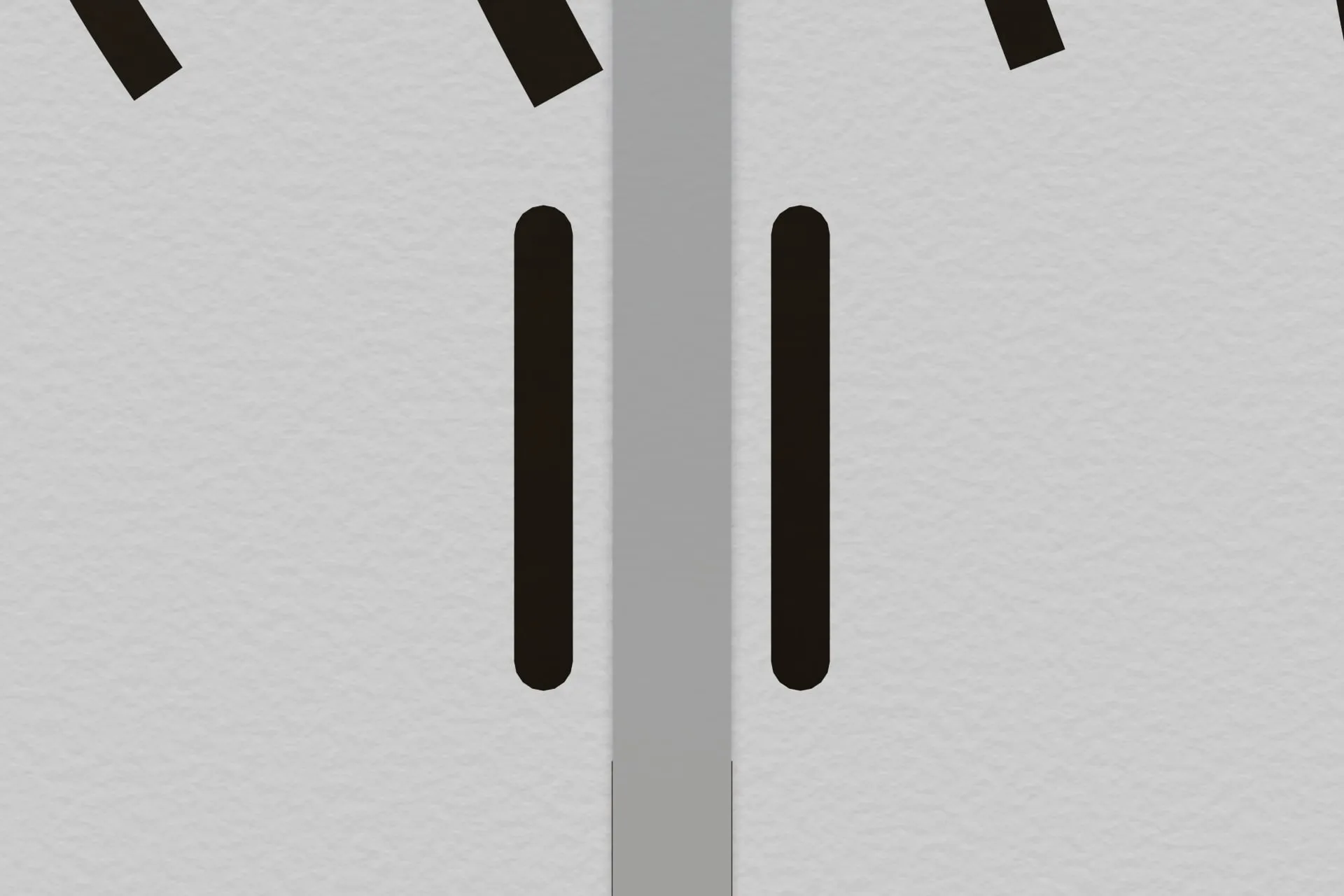
    The noon target beside the back of the gnomon at true solar noon: two short slots, with two light strips of equal width between them and the sides of the gnomon
    Correct: at true solar noon both strips are light and equally wide.
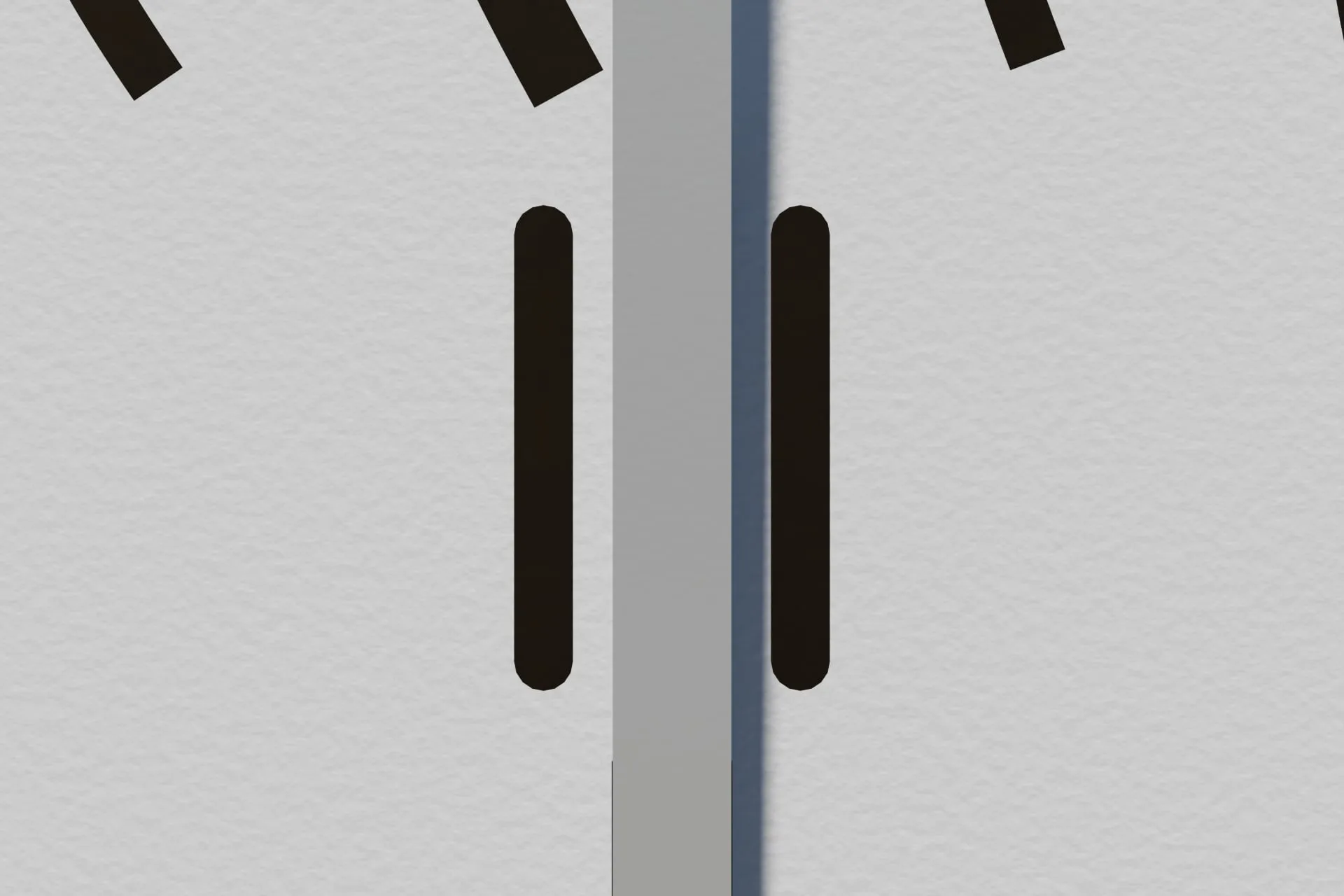
    The same moment with the dial plate turned 2° off: the gnomon’s shadow falls on the right-hand strip
    Turn it slightly: the dial plate is 2° off, and a shadow falls on the right-hand strip.

    You will need a spirit level, a drill with a 10 mm masonry bit, a pencil, a marker pen, a tape measure, a set square, two 13 mm spanners (or one 13 mm spanner and an adjustable spanner), a 2.5 mm hex key, a 5.5 mm spanner, a rubber mallet, a candle, petroleum jelly and two blocks 12–⁠15 cm high. The studs, nuts, washers, wall plugs and the locking discs with M3 screws are in the box.

    1. 01

      Gnomon and key

      Lay the dial plate on two blocks. Push the tab of the gnomon down into the slot in the dial plate and slide the gnomon towards the north, that is, towards the number 12 at the edge of the dial plate, until the end of the tab sits in the tip of the slot. Rub candle wax only on the sloping bottom of the slit in the tab that the key slides into. From below, fit the key with its notch facing up onto the south end of the tab and push it by hand towards the north as far as it will go, pushing the gnomon towards the north as you do so. With the marker pen, draw a line on the tab at the south face of the key. Then tap the key a further 1.5–⁠2 mm past the line with the mallet, holding the gnomon square to the dial plate with the set square. The south face of the key must end at least 0.5 mm north of the small 1 × 1 mm cut-out on the lower edge of the tab; if it is not there yet, keep tapping, but no more than 3 mm past the line. If even that is not enough, write to me.

    2. 02

      Key lock

      Degrease the locking disc, the screw head, the washer and the tab around the hole. Push the M3 screw from the west side through the disc and the hole in the tab. West is on the left when you look from the south towards the number 12. Fit the washer and the nut on the east side. Put a drop of petroleum jelly only on the end of the thread. Hold the screw with the hex key from the first turn and tighten the nut only so far that the disc can still be turned stiffly by hand. Turn the disc so that its wider part faces south, then turn it by hand up over the screw towards the north until it rests lightly against the key. The wider part must stay above the screw. Hold the disc against the key with a finger. Still holding the screw with the hex key, tighten only the nut with the 5.5 mm spanner to 0.8 N·m, about 1 kg of force 8 cm from the nut. Check against the light that there is no gap between the disc and the key. Finally, press the tip of the gnomon lightly sideways: nothing may click or have play; a little springiness is fine.

      After one or two weeks, and then once a year, tighten the nut of the key lock again in the same way as during assembly. To do this, lift the dial plate off the studs and leave the lower nuts in place. After refitting, fine-tune the dial plate at true solar noon. There is a spare lock set in the box.

    3. 03

      Studs

      Put a lower nut with a large washer on each of the three studs. From below, push each stud through the slot in its lug to the middle of the slot, opposite the small round hole at the edge of the lug, and secure it on top with a washer and a cap nut. Set the lower nuts on all three studs to the same height; you will set the exact height after mounting.

    4. 04

      Marking out the holes at true solar noon

      On the day of installation, at the time of true solar noon, stand the sundial on the post, level it roughly and turn it so that no shadow falls on either of the two light strips beside the back of the gnomon and both strips are equally wide. Trace round the foot of each stud with a pencil. The gnomon’s shadow lies here at noon all year round, so this can be done on any day.

      The noon target is only for aligning the dial plate. It shows true solar noon, not 12:00 on your watch.

    5. 05

      Drilling

      Lift the sundial off. At the centres of the traced circles drill holes 10 mm in diameter and 75 mm deep (mark the depth on the bit with tape), blow the dust out of them and push in the wall plugs flush with the surface.

      Wooden post: the stud screws into the wood without a wall plug. Pre-drill 6 mm for hardwood (oak, robinia) or 5 mm for softwood (spruce, pine), 70 mm deep.

    6. 06

      Mounting and levelling

      Take the studs out of the sundial: remove the cap nuts and the upper washers, and leave the lower nuts with their washers on the studs. Above the lower nut, run the fourth nut from the box onto the stud and tighten the two against each other. Using the upper nut, screw the stud into the wall plug until 55 mm stands above the post. Then loosen and remove the upper nut; the lower one stays on the stud and will carry the dial plate. Fit the sundial onto the studs through the slots in its lugs and, for now, secure it only lightly on top with the washers and cap nuts. Use the lower nuts to set the top surface of the dial plate 45 mm above the post, no lower, because the key is under the dial plate. Then level the dial plate: place the spirit level on it beside the gnomon and use the lower nuts to bring the bubble to the centre. Turn the spirit level through 90° and level again.

      Check: 6–⁠9 mm of the stud should show above the upper washer, so that the cap nut has enough thread and does not bottom out on the end of the stud. If less shows, unscrew the stud a little further.

    7. 07

      Fine adjustment at true solar noon

      On the next sunny day, at true solar noon, loosen the cap nuts and turn the dial plate in the slots until both strips of the noon target are light and equally wide. Then tighten the cap nuts. Leave the lower nuts as they are: they hold the height and the level. The studs start in the middle of the slots, so there are about 3° left on each side.

    On your sundial now

    The calculation needs JavaScript.

    Step 2

    Correction table

    A sundial shows local time by the Sun over your garden. Your watch shows Central European Time (CET), the same across Czechia, from Aš in the west to Ostrava in the east. The correction table converts the time on the sundial to the time on your watch. With it you can study the sundial in depth and, in theory, arrive at a very precise time.

    Your place: Prague, latitude 50.08° N, longitude 14.44° E.

    Minutes to add to the time on the sundial to get CET
    Month6 h7 h8 h9 h10 h11 h12 h13 h14 h15 h16 h17 h18 h
    January–––+3+2+2+2+2+2+2–––
    February––+2+2+2+2+2+2+2+2+2––
    March–+2+2+2+2+2+2+2+2+2+2+2–
    April+2+2+2+2+2+2+2+2+2+2+2+2+2
    May+2+2+2+2+2+2+2+2+2+3+3+3+3
    June+2+2+2+2+2+2+2+2+2+3+3+3+3
    July+2+2+2+2+2+2+2+2+2+3+3+3+3
    August+2+2+2+2+2+2+2+2+2+2+2+3+3
    September–+2+2+2+2+2+2+2+2+2+2+2–
    October–+2+2+2+2+2+2+2+2+2+2––
    November––+3+2+2+2+2+2+2+2–––
    December–––+3+2+2+2+2+2+2–––

    During summer time (CEST), add another 1 h. A dash: the Sun is lower than 5° above the horizon and the sundial cannot be read.

    For further study: the exact value for today

    Three influences

    When the sundial is set up well, only three influences make up the difference from your watch:

    1. Longitude (east–west). The sundial is calculated for the meridian at 15° east, which passes through Jindřichův Hradec and which Central European Time follows. West of it the Sun is due south later, east of it earlier. That is why west of it you add 4 minutes for each degree, and east of it you subtract them. The result is a longitude correction that does not change over the year, for example Prague about +2 min, Brno −6 min, Ostrava −13 min, Aš +11 min. Your longitude correction: +2.2 min.
    2. Latitude (north–south). The gnomon and the hour lines are calculated for latitude 49.8° N. Further north or south the gnomon is not exactly parallel to the Earth’s axis, so the correction changes with the hour and the season: it is zero at noon and largest on summer mornings and evenings. In Czechia it is at most about 2 minutes.
    3. The equation of time. The Earth orbits the Sun in an ellipse and its axis is tilted. This celestial mechanics makes the Sun run now ahead of your watch and now behind it over the year, by up to about a quarter of an hour. The wavy hour lines in the month rings already contain this swing, so you do not add it.

    How to use the table

    Read the time on the sundial in the ring for this month. In the table, find the row for this month and the column for the whole hour nearest to the time you read. Add the number from the table (in minutes) to the time you read, or subtract it if it is negative, and you have Central European Time (CET). The number from the table already includes the longitude correction and the latitude correction. During summer time (CEST), add another hour.

    The 12 h line has four small steps on the days when the equation of time passes through zero (around 15 April, 13 June, 1 September and 25 December); there the shadow jumps across the thickness of the gnomon.

    Example: Prague, 18 November, the sundial shows 10:00. The longitude correction is +2.25 min, the latitude correction that day at 10 h is +0.17 min, together +2.42 min, that is 2 min 25 s. Your watch shows 10:02:25 CET.

    Limitations

    The precision of the table goes beyond what the eye can read from the sundial. The edge of the shadow is slightly blurred and the time between the lines is estimated, so you can read the shadow to about a minute at best. The numbers in the table apply to the 15th day of the month and the whole hour; on another day and at another time they differ, in Czechia, by at most about half a minute. The result also depends on careful setup: the dial plate must be level and aligned at true solar noon using the noon target.
    For the garden

    Printable card

    The table and the times of true solar noon for your place on a single sheet. In the print dialogue you can also choose “Save as PDF”.

    Correction table: Prague

    50.0755° N, 14.4378° E

    janlochmann.com

    The numbers in the table are in minutes. They include the longitude correction (+2.2 min) and the latitude correction.

    1. Read the time on the sundial in the ring for this month.
    2. In the table, find the row for this month and the column for the whole hour nearest to the time you read.
    3. Add the number from the table to the time you read, or subtract it if it is negative. You have Central European Time (CET).
    4. During summer time (CEST), add another hour.

    The equation of time is already in the wavy hour lines, so you do not add it. The precision of the table goes beyond what the eye can read from the sundial: you can estimate the shadow to about a minute at best. The result also depends on careful setup: the dial plate must be level and aligned at true solar noon using the noon target.

    True solar noon in CET (one hour later in summer time, CEST)