Project
The Běchovice sundial
Working to the architects’ brief, I calculated, designed and engineered the sundial on the tower of the Ecumenical Chapel of Angels (Ekumenická kaple Andělů) on the new square in Prague-Běchovice. The guide shows how to read it right now, and further down you can see how it was made.
Sundial guide for the chapel · live
How to read the sundial on the chapel
In Central European Time (CET) read the upper row of small numbers marked ZIMA; in summer time (CEST) read the lower row of large numbers marked LÉTO.
--:--
When it is cloudy there is no shadow. The guide shows where it would fall, but it does not account for shade from nearby buildings and trees.
Why a sundial does not agree with your watch
A sundial shows local apparent solar time: noon is when the Sun stands due south. A watch shows zone time, the same across the whole country. The difference has two parts, and today it looks like this:
- Equation of time
- —
- The Earth moves round the Sun on an ellipse with a tilted axis, so during the year the Sun reaches the south up to 16 minutes earlier or 14 minutes later.
- Longitude
- −1 min 34 s
- Central European Time is set for the 15° E meridian; the chapel stands at 14.61° E, so the Sun culminates here 1 min 34 s later.
- Total today
- —
The sundial is calculated for local solar time, without a longitude correction. Summer time does not change the correction, only the row: the lower row is shifted by one hour.
Four times a year, around 22 Apr, 5 Jun, 6 Sep and 22 Dec, the correction is zero and the sundial agrees with a watch.
The correction and the Sun on the wall through 2026
| Date | Sundial | To get watch time | Row | Sun on the wall |
|---|---|---|---|---|
| 1 Jan | 5 min behind | add 5 minutes | upper ZIMA | 8:07 → 16:03 |
| 15 Jan | 11 min behind | add 11 minutes | upper ZIMA | 8:01 → 16:22 |
| 1 Feb | 15 min behind | add 15 minutes | upper ZIMA | 7:41 → 16:50 |
| 15 Feb | 16 min behind | add 16 minutes | upper ZIMA | 7:18 → 17:14 |
| 1 Mar | 14 min behind | add 14 minutes | upper ZIMA | 6:51 → 17:38 |
| 15 Mar | 10 min behind | add 10 minutes | upper ZIMA | 6:31 → 18:01 |
| 1 Apr | 5 min behind | add 5 minutes | lower LÉTO | 7:48 → 19:17 |
| 15 Apr | 2 min behind | add 2 minutes | lower LÉTO | 8:02 → 18:55 |
| 1 May | 1 min ahead | subtract 1 minute | lower LÉTO | 8:18 → 18:33 |
| 15 May | 2 min ahead | subtract 2 minutes | lower LÉTO | 8:31 → 18:19 |
| 1 Jun | 1 min ahead | subtract 1 minute | lower LÉTO | 8:45 → 18:08 |
| 15 Jun | 2 min behind | add 2 minutes | lower LÉTO | 8:53 → 18:05 |
| 1 Jul | 5 min behind | add 5 minutes | lower LÉTO | 8:56 → 18:10 |
| 15 Jul | 8 min behind | add 8 minutes | lower LÉTO | 8:51 → 18:18 |
| 1 Aug | 8 min behind | add 8 minutes | lower LÉTO | 8:38 → 18:33 |
| 15 Aug | 6 min behind | add 6 minutes | lower LÉTO | 8:21 → 18:46 |
| 1 Sep | 2 min behind | add 2 minutes | lower LÉTO | 7:56 → 19:01 |
| 15 Sep | 3 min ahead | subtract 3 minutes | lower LÉTO | 7:34 → 19:10 |
| 1 Oct | 9 min ahead | subtract 9 minutes | lower LÉTO | 7:08 → 18:35 |
| 15 Oct | 13 min ahead | subtract 13 minutes | lower LÉTO | 7:29 → 18:05 |
| 1 Nov | 15 min ahead | subtract 15 minutes | upper ZIMA | 6:57 → 16:33 |
| 15 Nov | 14 min ahead | subtract 14 minutes | upper ZIMA | 7:20 → 16:11 |
| 1 Dec | 9 min ahead | subtract 9 minutes | upper ZIMA | 7:45 → 15:56 |
| 15 Dec | 3 min ahead | subtract 3 minutes | upper ZIMA | 8:00 → 15:53 |
The correction is calculated for noon; the times when the Sun is on the wall are watch times (CET, or CEST during summer time). In other years the correction differs by a few tens of seconds at most, and the times on the wall by a minute or two.

01 Process
How the sundial came together
-
Calculation and digital twin
First, the calculation: from the position of the chapel and the direction the tower wall faces, I worked out where the hour lines would run and how the gnomon, the part that casts the shadow, had to sit. Then, before anything was made, I used a digital twin of the tower, turned exactly as the real building stands, to check that the shadow tells the right time at every hour and on every day of the year.
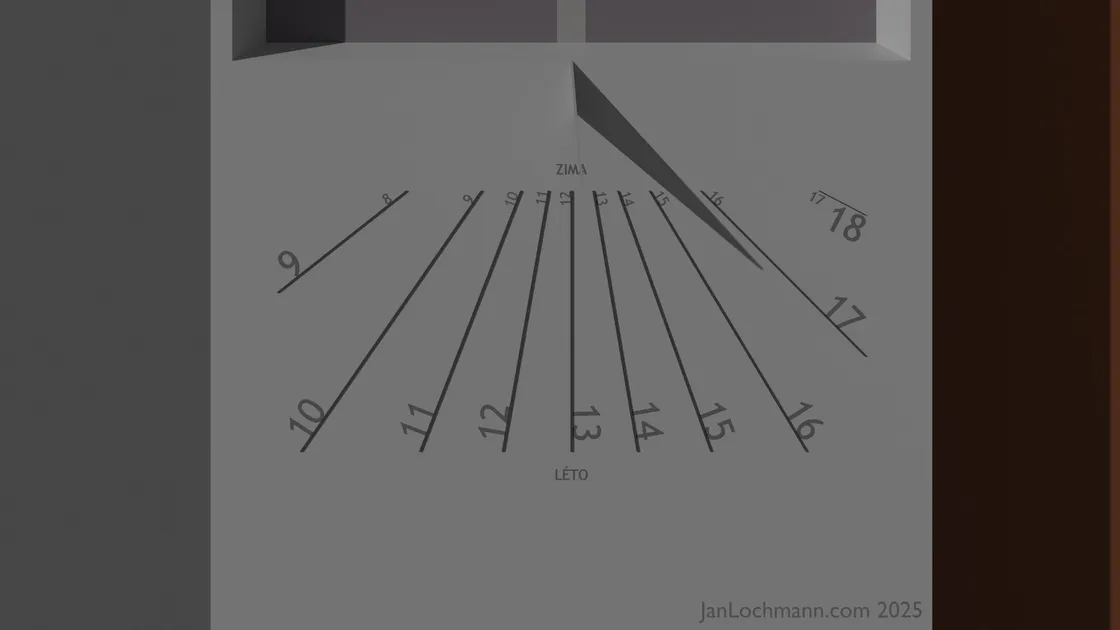
The digital twin of the tower on 9 September 2025, two months before the gnomon was set. -
Setting the gnomon on the scaffolding
The gnomon is a massive welded steel piece made from 13 mm plate, and the accuracy of the whole sundial depends on its angle. As it went into the unfinished facade of the tower, I took all the measurements with my drawing, a protractor and a spirit level and determined exactly where the gnomon would sit and at what angles.
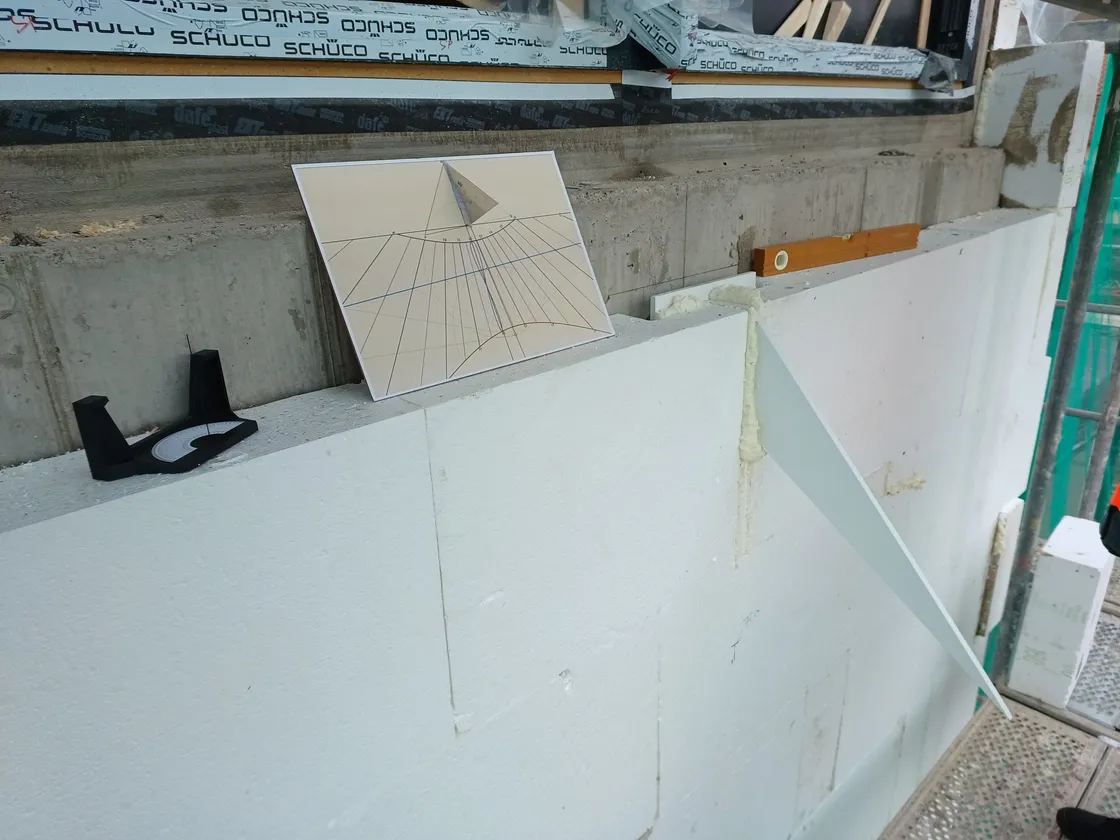
The hour lines still only on paper, the gnomon already in the wall. 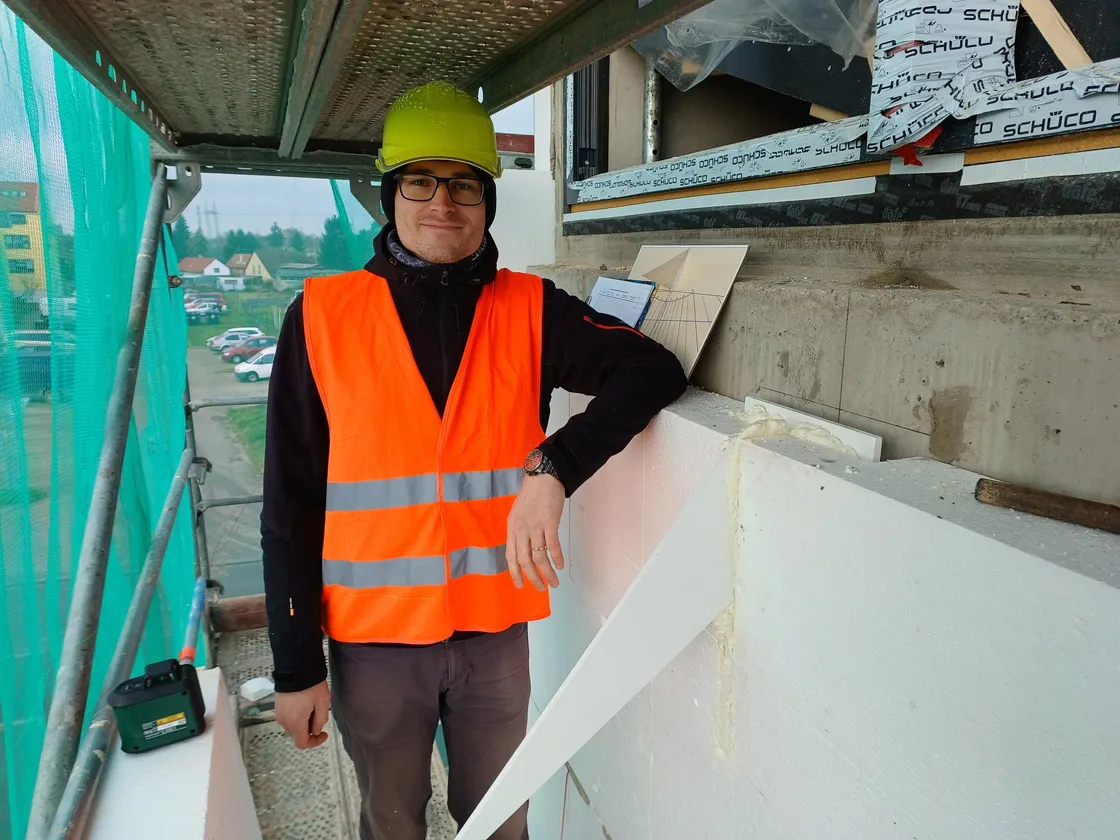
Me beside the freshly set gnomon. Within a few months the white facade and the dial would be finished around it. -
The finished sundial
The tower is finished, dial and all. The 17-metre chapel opened in 2026, and the sundial can be seen from right across the new square.
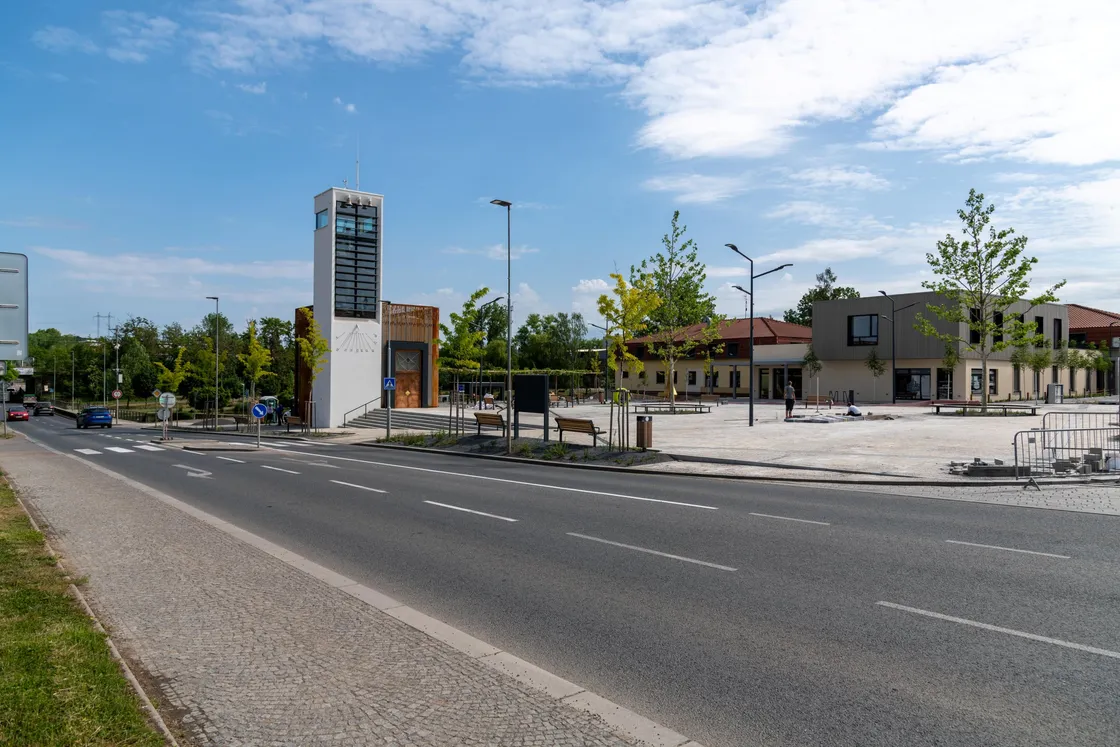
The chapel from the road. Look for the dial on the white tower on the left.


02 The dial
How the sundial tells the time
The gnomon’s shadow, below the tower window, tells the time. During the day it travels across the fan of hour lines from left to right.
The two rows of numbers are there because of summer time, so you never have to add an hour. The upper row of small numbers 8–17, marked ZIMA (winter), is for Central European Time (CET, standard time); the lower row of large numbers 9–18, marked LÉTO (summer), is for summer time (CEST), from the end of March to the end of October. The vertical noon line is numbered 12 at the top and 13 at the bottom.
The sundial shows local apparent solar time, with no longitude correction. Like any such sundial, it naturally runs ahead of and behind your watch over the year, by up to 16 minutes. Most of the difference is the equation of time, which comes from the Earth’s elliptical orbit round the Sun and the tilt of its axis. On top of that comes a constant difference in longitude: the chapel stands at 14.61° E, Central European Time is set for the 15° E meridian, and that makes about 1.5 minutes. The guide at the top of the page shows how much it is today.
Four times a year the correction of the sundial is zero (around 22 April, 5 June, 6 September and 22 December), and on those days the sundial agrees with a watch. I took the photograph on 30 May 2026, a few days before one of them; the correction was then only about a minute. That is why at 9:59 CET the shadow lies exactly on the line marked 10 in the upper row and 11 in the lower, summer row.

The sundial at a glance
- Where
- Ecumenical Chapel of Angels, Běchovice square, Prague
- Calculated for
- ≈ 50.08° N, 14.61° E
- Wall orientation
- 5.2° west of south
- Type
- vertical sundial on the tower wall
- Architects of the chapel and square
- Milena and Ondřej Tomek, Tomek architekti
- Client
- Prague-Běchovice municipal district
- My part
- calculation, design and engineering; checking on a digital twin; measuring and positioning the gnomon when it was set
For developers
A sundial for new public squares
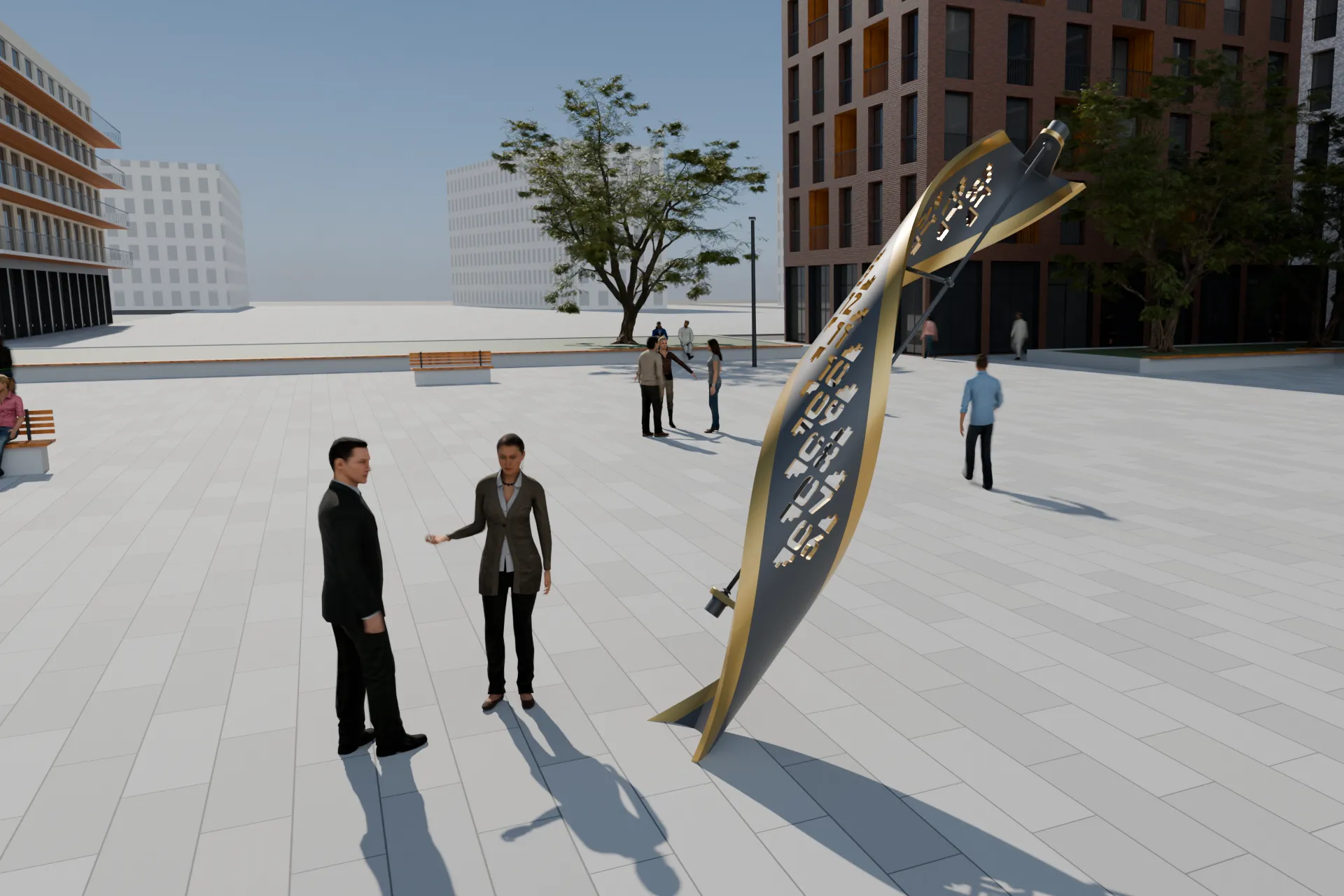
The Běchovice sundial is on the chapel tower on a new square. For the squares of other developments I offer a polar sundial calculated for the specific site: the Sun shines through numbers cut into a ribbon, and a cable’s shadow on them shows the time.
Would you like a sundial too?
I’ll calculate, design and engineer one for your own wall, and when the gnomon is set, I’ll measure where it goes and at what angles myself. Tell me what building you have in mind.