Garden Sundial H50 Mk1
A sundial that knows the whole year
A horizontal dial plate of stainless steel sheet for a post in your garden. Each month has its own ring, and the wavy hour lines carry the equation of time. With the correction table for your place it tells the time to within about a minute.
In preparation
CZK 2,990 final price, I am not VAT-registered
The first pieces are now being laser-cut as a trial. Orders will open once they are right.
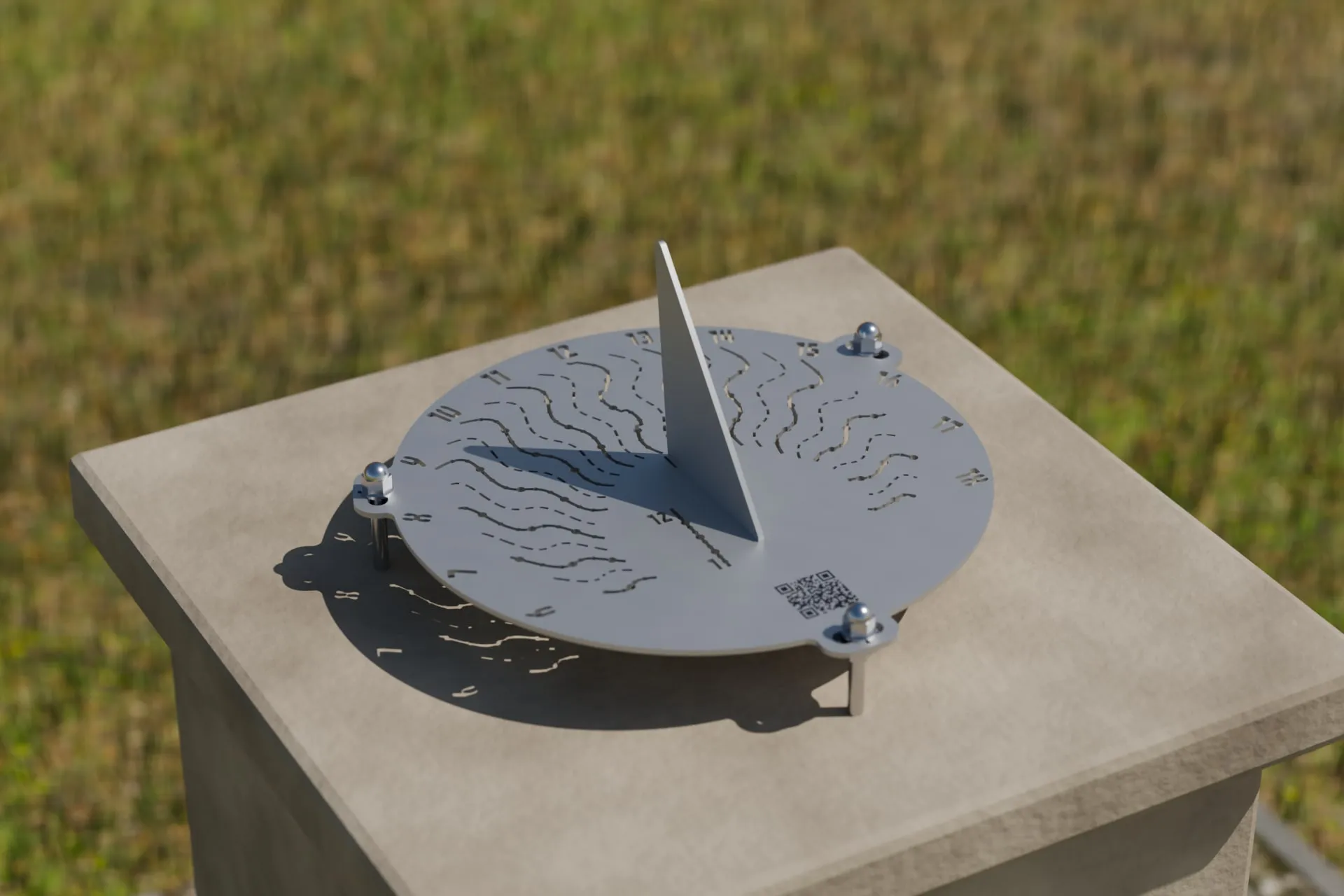
- 300mmdiameter of the 3 mm stainless steel dial plate
- 12ringsone for each month; the equation of time is in the lines
- 1minaccuracy in Czechia after the correction for your place
- 2kgmounted on a post with three M8 studs
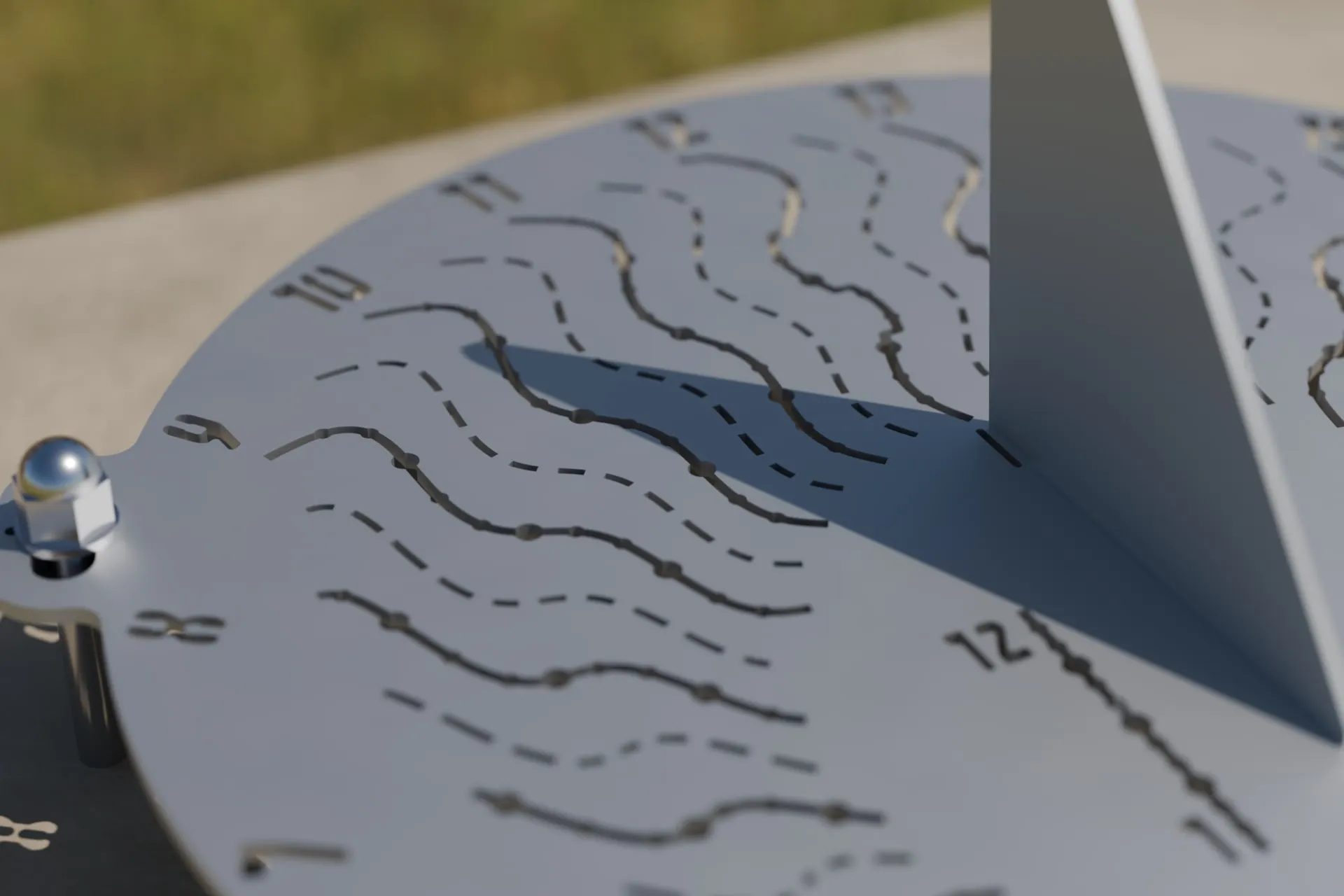
21 June in Prague: the shadow edge crosses the June ring on line 10. The sundial shows 10:00; it is 10:02 CET (11:02 CEST in summer time). 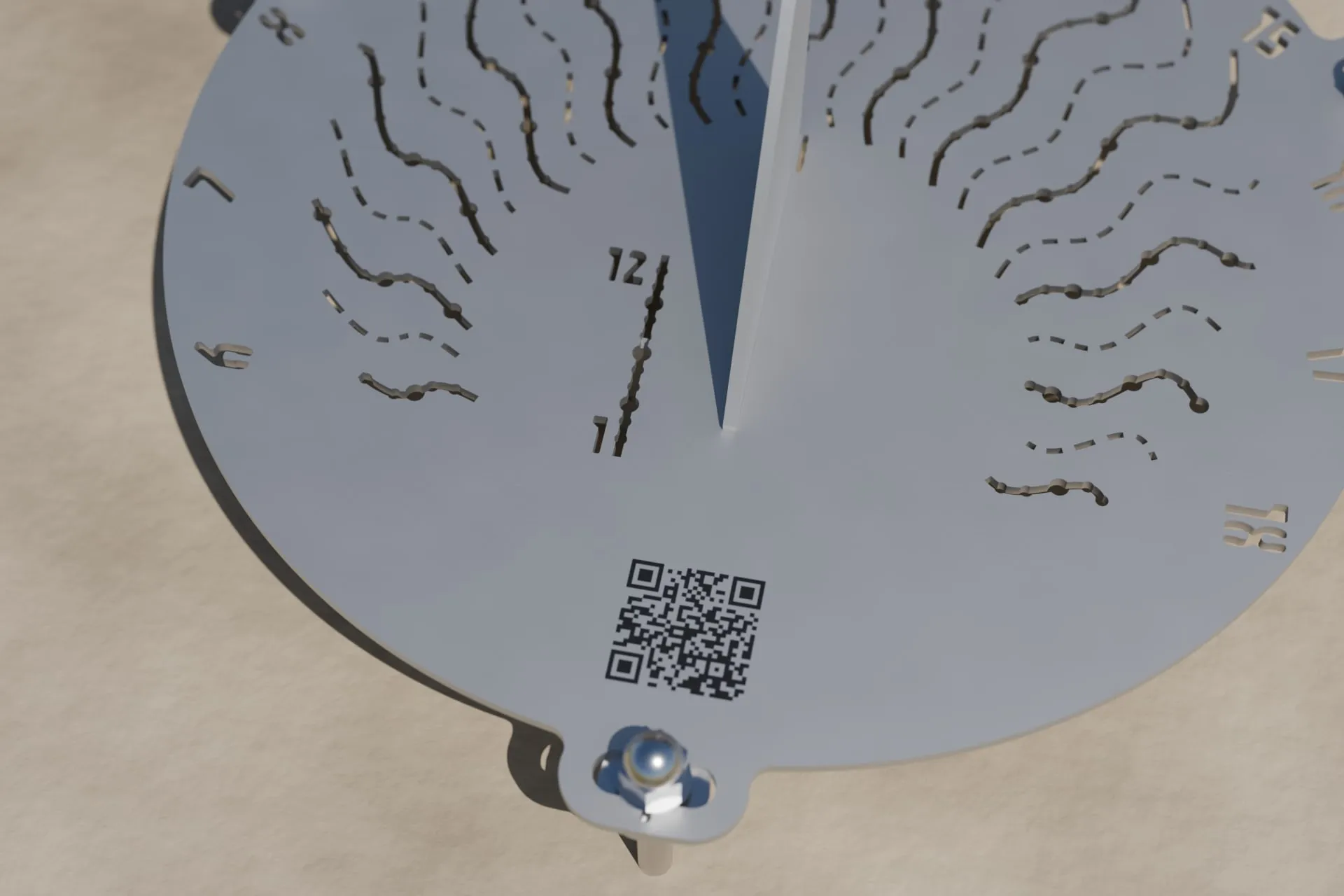
The month legend beside the gnomon and a QR code that leads to this page. 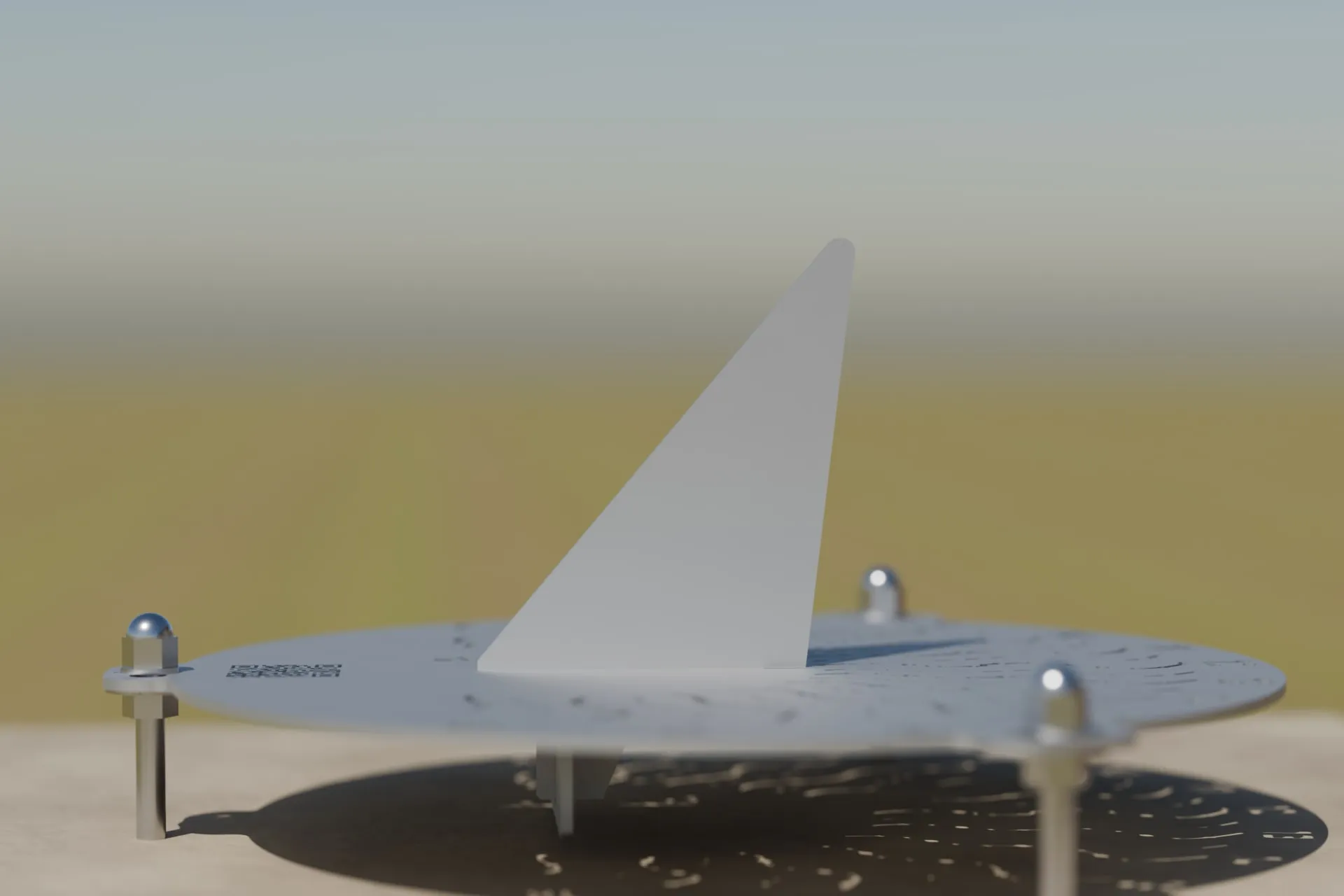
The gnomon is cut from a single sheet and tilted for latitude 49.8° N.
Reading
How to read it
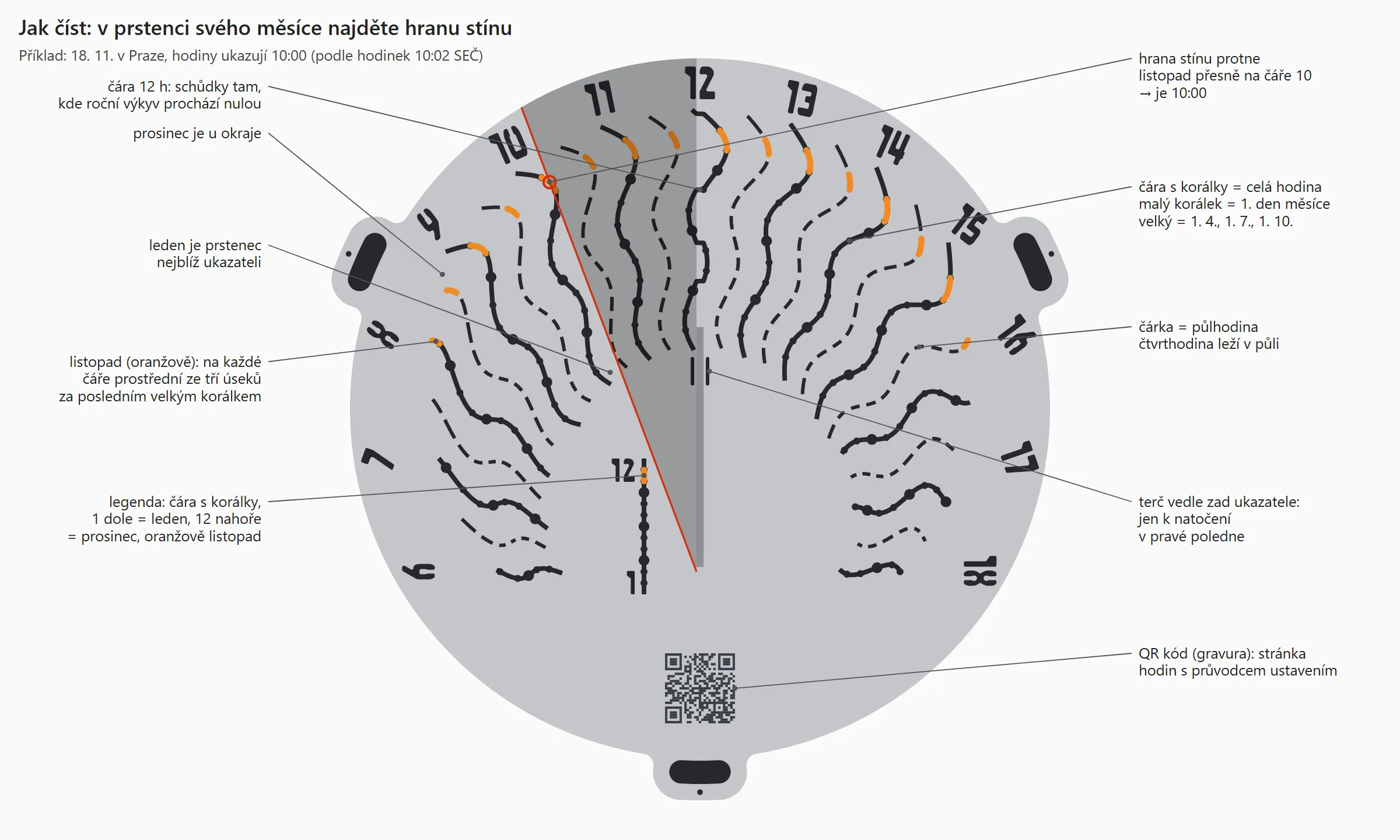
- 01
Find this month’s ring
January is the ring nearest the gnomon, December the one at the edge. The legend beside the gnomon shows the order: a line of beads with 1 at the bottom and 12 at the top.
- 02
Look at the edge of the shadow
Read the time where the edge of the gnomon’s shadow crosses this month’s ring.
- 03
A line is an hour, a tick half an hour
The wavy line with beads is the full hour, the tick the half hour; the quarter hour lies halfway between line and tick.
- 04
The beads are dates
A small bead marks the 1st day of a month, the large beads 1 April, 1 July and 1 October.
Time
What time it shows
The sundial shows the local mean time of the 15° E meridian. That meridian runs through Jindřichův Hradec in southern Bohemia, and Central European Time (CET) is based on it.
The Earth orbits the Sun in an ellipse and its axis is tilted. This celestial mechanics makes the Sun run ahead of your watch for part of the year and behind it for the rest, by up to about a quarter of an hour. This yearly swing, the equation of time, is already built into the wavy hour lines, so you don’t add it.
What remains is the correction for your place: a fixed longitude correction and a small latitude correction. The guide on this site works out both; during summer time (CEST) you add one more hour.
Fixed longitude correction
- Aš
- +11 min
- Prague
- +2 min
- Brno
- −6 min
- Ostrava
- −13 min
West of the 15° meridian you add 4 minutes for each degree, east of it you subtract them. In Czechia the latitude correction is at most about 2 minutes.
Setup
You set it up yourself, with the guide
- 01
Marking out at true solar noon
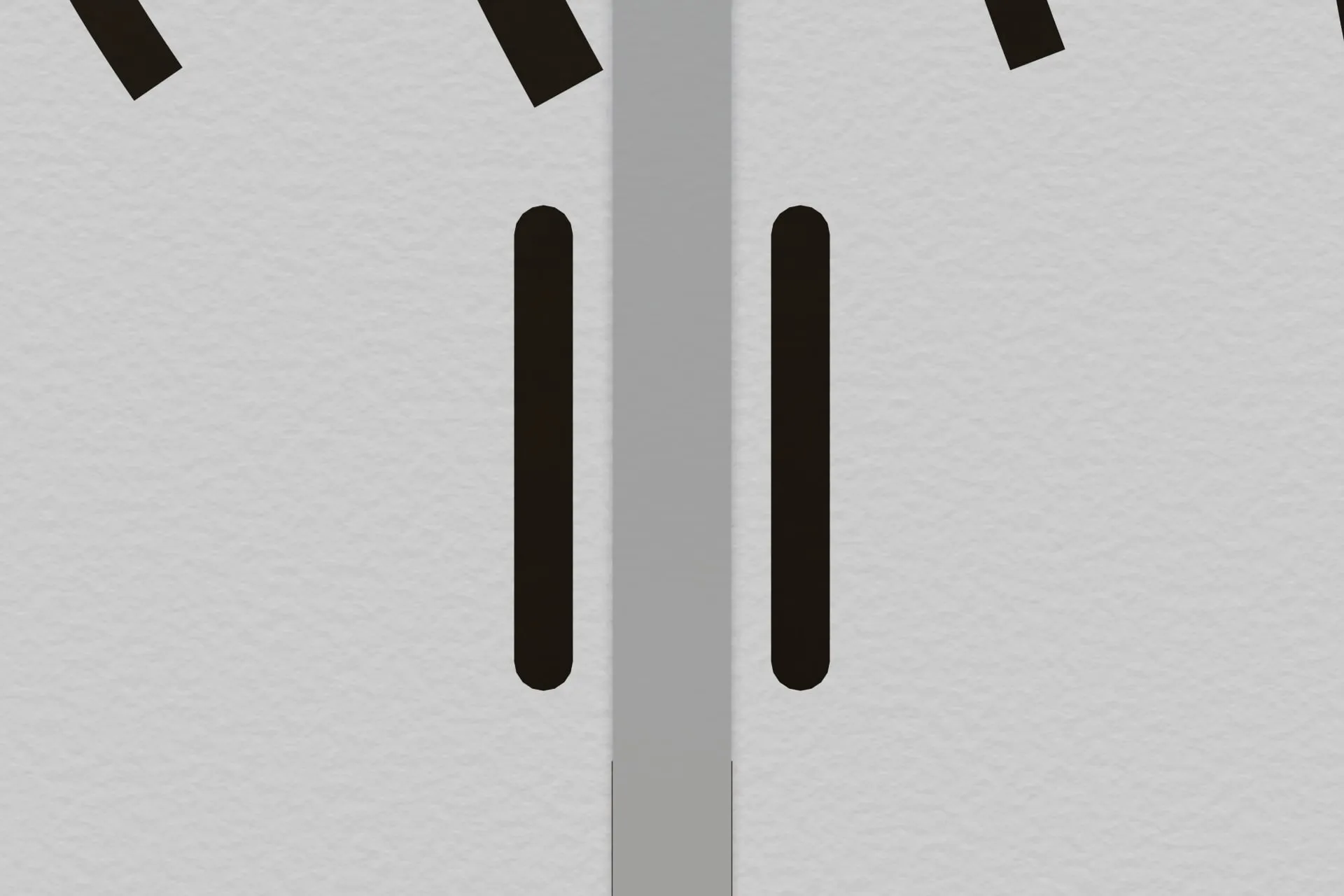
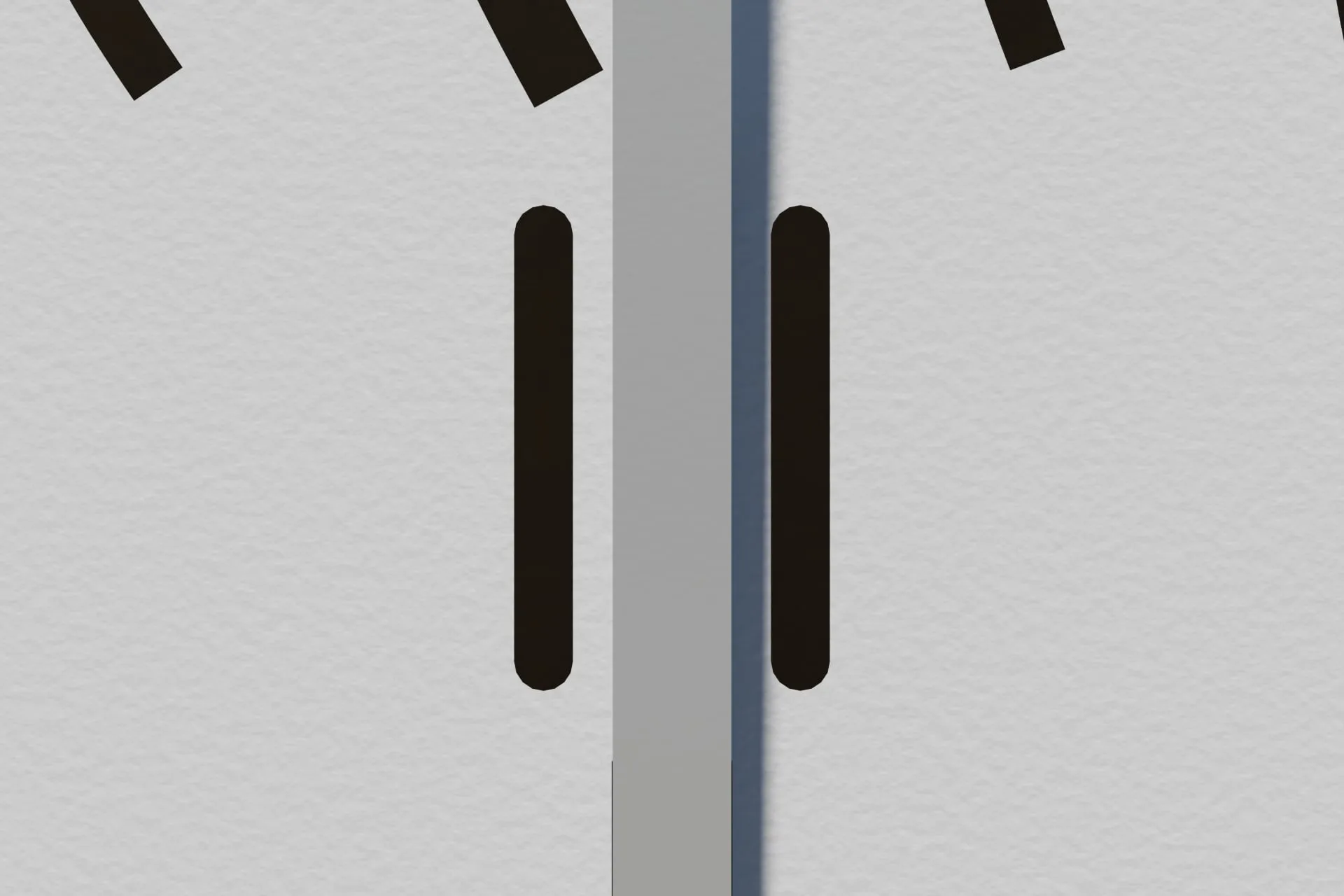
At true solar noon, stand the sundial on the post and turn it so that no shadow falls on either of the two light strips beside the back of the gnomon and both are equally wide. Trace round the feet of the studs with a pencil; these marks show where to drill the holes. The guide works out your true solar noon to the second.
- 02
Levelling and fine-tuning
Screw the sundial down and level it with the lower nuts. At the next true solar noon you fine-tune the alignment in the slots of the lugs: the studs start in the middle, leaving about 3° each way.
- 03
Correction table
The guide builds the table for your place and also prepares it as a printable card. With it you convert the sundial’s time to clock time.
Specifications
What it is made of
- Material
- 3 mm stainless steel sheet, all parts laser-cut
- Dial plate
- round, Ø 300 mm, with three lugs for studs; 316 × 318 mm including the lugs
- Gnomon
- cut from a single sheet, fixed at the angle for latitude 49.8° N; held under the plate by a key secured with a disc on an M3 screw
- Mounting
- on a post with three M8 studs; the dial plate sits 45 mm above the post, and the alignment can be fine-tuned by about 3° each way in the slots of the lugs
- Instructions
- a QR code engraved on the dial plate leads to this page, with a button to the setup guide at the top
- Post
- at least 42 × 42 cm, or round Ø 42 cm, with the sundial in the centre
- In the box
- stainless steel dial plate, gnomon, key and two key lock sets (one spare), each with a locking disc, M3 screw, nut and washer; three M8 × 120 hanger bolts (studs) with four nuts, washers and cap nuts; three 10 mm wall plugs; a printed A5 card with a link to the setup guide
- Weight
- about 2 kg (1.8 kg of stainless steel plus fixings)
- Package
- about 35 × 35 × 4 cm
- Time
- local mean time of the 15° E meridian; the equation of time is in the lines
- Accuracy
- in Czechia to about a minute after correction

In preparation
Garden Sundial H50 Mk1
stainless steel, Ø 300 mm, for the band around 50° N
CZK 2,990 final price, I am not VAT-registered
The first pieces are now being laser-cut as a trial. Orders will open once they are right.
- Sales
- to Czechia and Slovakia
- Setup
- the guide on this site works out true solar noon and the correction table for your place